
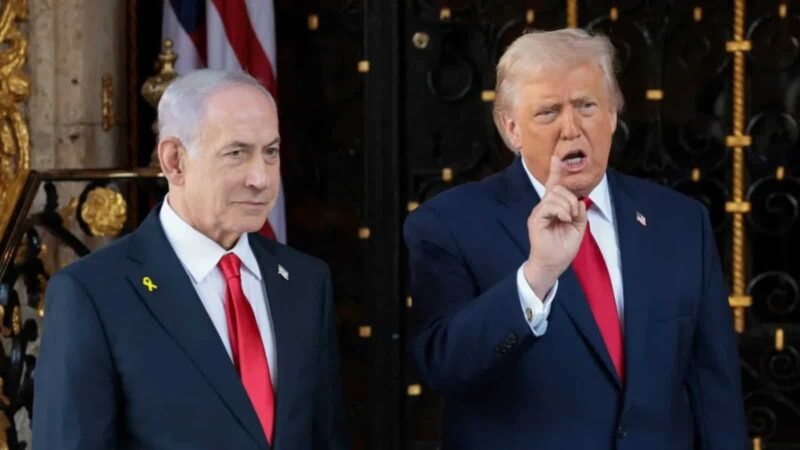

Prominent American conservative journalist Tucker Carlson has warned that the Trump administration could be days away from launching a nuclear strike on Iran, alleging that Israeli Prime Minister Benjamin Netanyahu is pressuring US President Donald Trump to authorise the attack.
In a lengthy post on X on Monday, November 2, Carlson identified Pickaxe Mountain in central Iran as a potential target, claiming that Israeli intelligence believes Tehran has restarted its nuclear enrichment programme at the underground facility.
He argued that conventional American weapons could not penetrate the mountain’s estimated 300 feet of solid granite to destroy the tunnels where enrichment is supposedly taking place, leaving a nuclear strike as the only military option.

“Netanyahu has been pushing hard for one. ‘Bibi calls Trump about it every day,’ says an informed observer,” Carlson wrote.
Carlson linked Netanyahu’s alleged push for military action to the Israeli prime minister’s political difficulties following recent election results. He claimed Netanyahu needed Trump’s intervention to secure the 61 seats required for a majority in the Knesset.
Without such support, Netanyahu could lose office and face investigations and possible imprisonment, Carlson alleged.
“Netanyahu must stay close to Trump. He needs this war,” he wrote.
Carlson further claimed that Netanyahu had been lobbying senior Trump administration officials, including Defence Secretary Pete Hegseth and CENTCOM commander Brad Cooper, to resume major military operations against Iran rather than pursue a negotiated settlement.
He also named Secretary of State Marco Rubio and CIA Director John Ratcliffe among officials allegedly following Netanyahu’s position. Carlson additionally claimed that former US president Barack Obama had opposed the Iran peace proposal being drafted in Doha.
He alleged that Netanyahu secretly travelled to Abu Dhabi on September 27 to seek the UAE’s support for a final military campaign against Iran. However, according to Carlson, the Emirates refused to join the effort.
Carlson warns of global consequences
Carlson warned that further military escalation could have severe economic and environmental consequences, particularly for Gulf countries already affected by disruptions to energy supplies and commercial shipping.
He said five supertankers were badly damaged in the Strait of Hormuz on October 11, arguing that continued attacks on commercial shipping could deepen disruptions to global oil and fertiliser markets. He warned that the situation could push the global economy towards a depression.

“A nuclear strike would radically accelerate the destruction,” he wrote.
Carlson also warned that radioactive fallout from a ground-level nuclear explosion at Pickaxe Mountain could contaminate the Persian Gulf and threaten drinking water supplies for around 100 million people.
Beyond the Middle East, he argued that a US nuclear attack on Iran could establish a dangerous precedent for other nuclear-armed countries.
He claimed Russia had told at least two governments that an American nuclear strike on Iran would give Moscow justification to use nuclear weapons against Ukraine. He also raised concerns about possible nuclear escalation between India and Pakistan and a North Korean attack on South Korea.
“After the first nuclear strike, World War Three is inevitable. That war would be short and final,” Carlson wrote.
He further alleged that the Trump administration had quietly revised US nuclear doctrine since February to make the first use of so-called battlefield nuclear weapons easier.
Carlson claimed that Trump could decide by Saturday, November 7, whether to use nuclear weapons against Iran. However, he said the US president was still considering advice from Vice President JD Vance and his envoy Steve Witkoff, who favoured reaching an agreement with Tehran instead of resuming military action.
He acknowledged that negotiations would be difficult, particularly after the killing of former Iranian Supreme Leader Ayatollah Ali Khamenei and members of his family in February. He claimed that some elements of Iran’s government had become more radical since the killings, complicating diplomatic efforts.

However, citing people who had spoken to Iranian decision-makers, Carlson said there was a consensus in Tehran that further conflict would harm all sides and that a diplomatic agreement was worth pursuing.
He concluded by calling on the international public to speak out against the possibility of a nuclear attack, warning that millions of people could face devastating consequences.
Trump and Netanyahu discuss Iran
Carlson’s claims come amid diplomatic efforts to resume negotiations between Washington and Tehran. Qatari mediators held discussions with Iranian officials for a third consecutive day on Sunday, November 1, to facilitate an agreement that could pave the way for direct talks between the two countries.
Trump and Netanyahu also discussed Iran during a phone conversation on Saturday, October 31, according to a report by Axios. Netanyahu reportedly pressed for fresh strikes after the US midterm elections, while Trump wanted to allow negotiations to continue.
Speaking to reporters on October 31, Trump said negotiations with Iran were “going fine” and that he was “not in much of a hurry”. However, he indicated that the US still needed to take action against one or two Iranian nuclear sites.
“We can do that in 10 minutes. We have that planned. You can look at Pickaxe Mountain. We need to take care of that. We can do that very quickly,” Trump said.
US Secretary of State Marco Rubio said on October 31 that Trump had not decided whether to authorise further strikes against Iran, adding that the president preferred a diplomatic resolution.
Meanwhile, Iran’s Supreme Leader Ayatollah Mojtaba Khamenei ordered the armed forces on October 31 to prepare for a possible attack. The military subsequently announced measures to strengthen its readiness.
How the US-Israel war with Iran unfolded
The US and Israel launched military strikes against Iran on February 28, prompting Tehran to retaliate against Israel and US targets across the region. A ceasefire was reached in April.
On June 18, the US and Iran signed a memorandum of understanding on freedom of navigation in the Strait of Hormuz. However, its implementation stalled amid disagreements over security arrangements.
Get the latest updates in Hyderabad City News, Technology, Entertainment, Sports, Politics and Top Stories on WhatsApp & Telegram by subscribing to our channels. You can also download our app for Android and iOS.
Source: The Siasat Daily