

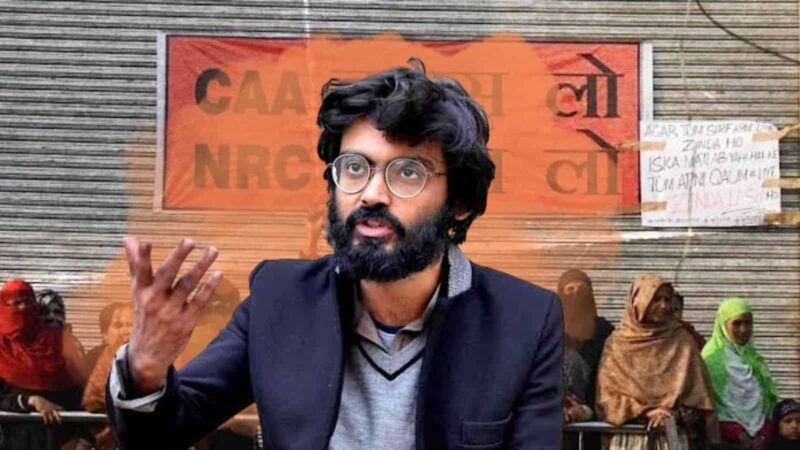

Ibn Khaldun Bharati’s column in ThePrint on October 17 treats Sharjeel Imam’s long interview with The Quint as a charge sheet. Imam’s views, he writes, are anti-liberal, anti-secular, anti-democracy, anti-Constitution and, finally, “anti-national.” The labels carry the argument. The interview itself, with its sustained case about representation, centralisation and the place of Muslims in a first-past-the-post democracy, gets far less attention.
One need not agree with Imam to see that he has been misread. His ideas can be contested on their own terms. They should not be filed away as a security problem.
What Imam actually wrote
Bharati says Imam calls the Constitution fascist. The interview does not say so. Imam calls the Constitution a “roadblock” to the dignified existence of religious minorities. He keeps the word “trap” for the secular consensus, the belief that returning the Congress to power will by itself keep Muslims safe.
These are harsh verdicts, but Indian politics has heard harsher. MS Golwalkar, in “Bunch of Thoughts” (1966), called the Constitution “a cumbersome and heterogeneous piecing together” of Western provisions. BR Ambedkar told the Rajya Sabha on September 2, 1953, that he would be “the first person to burn it out,” while arguing that governors needed powers to shield Dalits and linguistic minorities in the new Andhra state. Few would call that sedition.
Imam’s remedies are electoral. He wants proportional representation and Muslim reservation with a share for backward castes. He also wants Scheduled Caste status for Dalit Muslims and Christians, decentralisation and elected waqf boards. He proposes to pursue all this through new parties, alliances and peaceful agitation. Every item on the list may be wrong. Pressing for it this way is still constitutional politics.
The numbers explain why he finds listeners. Muslims were 14.2 per cent of the population in the 2011 Census. The Lok Sabha elected in 2024 has 24 Muslim MPs, about 4.4 per cent of the House. Under first-past-the-post, a scattered minority can turn out in large numbers and win very little. One of Imam’s examples has nothing to do with Muslims: the Bahujan Samaj Party (BSP) polled over four per cent of the national vote in 2014 and won no seat.
A Pakistan within India?
Bharati’s gravest charge is that Imam’s talk of autonomy hides “a Pakistan within the borders of India.” This, he says, is the state within a state that Maududi imagined in 1938. Imam has handed his critics some material here. He calls South Asian Muslims the largest Muslim nation. Among the Iqbal quotations attached to the interview is the 1930 claim that a Muslim India within India is justified.
Yet, he is explicit about what he means. Two nations, he writes, “never meant two geographical nations.” He means religious communities spread across the subcontinent who needed a constitutional settlement, and his reference point is the Cabinet Mission Plan of 1946.
On electorates, he is more careful than his critics allow. In a 2025 prison essay for the Polis Project, he notes that separate electorates stop Hindus and Muslims from voting for each other and prefers proportional representation instead. That is a case for sharing power inside one republic. It may be naive. It is no blueprint for secession.
His history of Partition, which blames the Congress and praises Jinnah, is open to serious challenge. Argue with it, by all means, but as what it is.
Shirk, Dalits and coalitions
Much of Bharati’s case rests on theology. Imam does describe shirk, or polytheism, as the root of oppression, and Bharati concludes that Hinduism must be his target. Imam’s own list of shirk’s branches, however, is superstition, despotism, nationalism, materialism and casteism. Hinduism is Bharati’s addition.
The same leap produces the charge that Islamists want Dalits and tribals as “foot soldiers.” Imam proposes alliances with Dalit, Adivasi, Dravidian, Lohiaite and Left forces. Muslims would back them on decentralisation in return for their support on minority demands. That is coalition bargaining, and Dalit voters are quite able to judge it. Badri Narayan’s “The Making of the Dalit Public in North India” (2011) shows how deliberately they have built their own politics in Uttar Pradesh.
Then there is the 2020 speech at Aligarh Muslim University, where Imam asked non-Muslim sympathisers to stand with Muslims “on our terms.” The same speech contained the remark about “cutting off” Assam that led to one of the sedition cases against him. He says he meant a chakka jam, a road blockade.
As he points out, the Allahabad High Court, granting him bail, recorded that it was undisputed he had neither called for arms nor incited violence. Asking for support on Muslim terms is a claim about who sets the agenda. Frantz Fanon, in “The Wretched of the Earth” (1961), insisted that the oppressed must be the authors of their own politics.
Swami’s analogies
Praveen Swami’s column in ThePrint on October 23 is kinder. Its warning, that India may be inventing an enemy it cannot defeat, deserves attention. Its weakness is method.
Swami begins with Syed Ahmad of Rae Bareli, killed at Balakot in 1831. He traces to him both Imam’s rejection of secularism and the state’s drive to keep Imam in prison. The symmetry is neat. Still, it places a man arguing about voting systems in the lineage of a jihad against Ranjit Singh, without showing what connects them beyond mood.
His Students Islamic Movement of India (SIMI) comparison comes closer. Swami recalls stickers from around SIMI’s 2001 Mumbai convention stamping “NO” over democracy, nationalism and polytheism. Imam does count nationalism as a branch of shirk, so the shared vocabulary is real. The programmes are another matter. SIMI rejected democracy; Imam wants to change the voting system and contest elections.
Swami’s finest passages describe the Raj’s Wahhabi trials of the 1860s and 1870s and detention without charge under Act III of 1858. All of it was driven by fear of an uprising that never came. Read carefully, that history is the best argument against his own method.
The silence that matters
Bharati’s headline promises that the silence of liberals will be remembered. The premise is shaky. The interview had drawn criticism, in ThePrint among other places, before his column appeared, and The Quintlater ran a point-by-point rebuttal.
Meanwhile Imam has been an undertrial since January 2020. On January 5, 2026, the Supreme Court refused him bail in the Delhi riots conspiracy case, while releasing five co-accused.
WEB Du Bois described double consciousness as measuring one’s soul by the tape of a world that looks on in contempt. Muslims who argue about representation in India know that measure well. They must prove they are not what their critics fear before anyone hears them out. A confident democracy can answer Imam’s case on its merits. It should not need to misquote him to do so.
Get the latest updates in Hyderabad City News, Technology, Entertainment, Sports, Politics and Top Stories on WhatsApp & Telegram by subscribing to our channels. You can also download our app for Android and iOS.
Source: The Siasat Daily